
Dean's List: 2025
The 61 best albums of last year (or so)
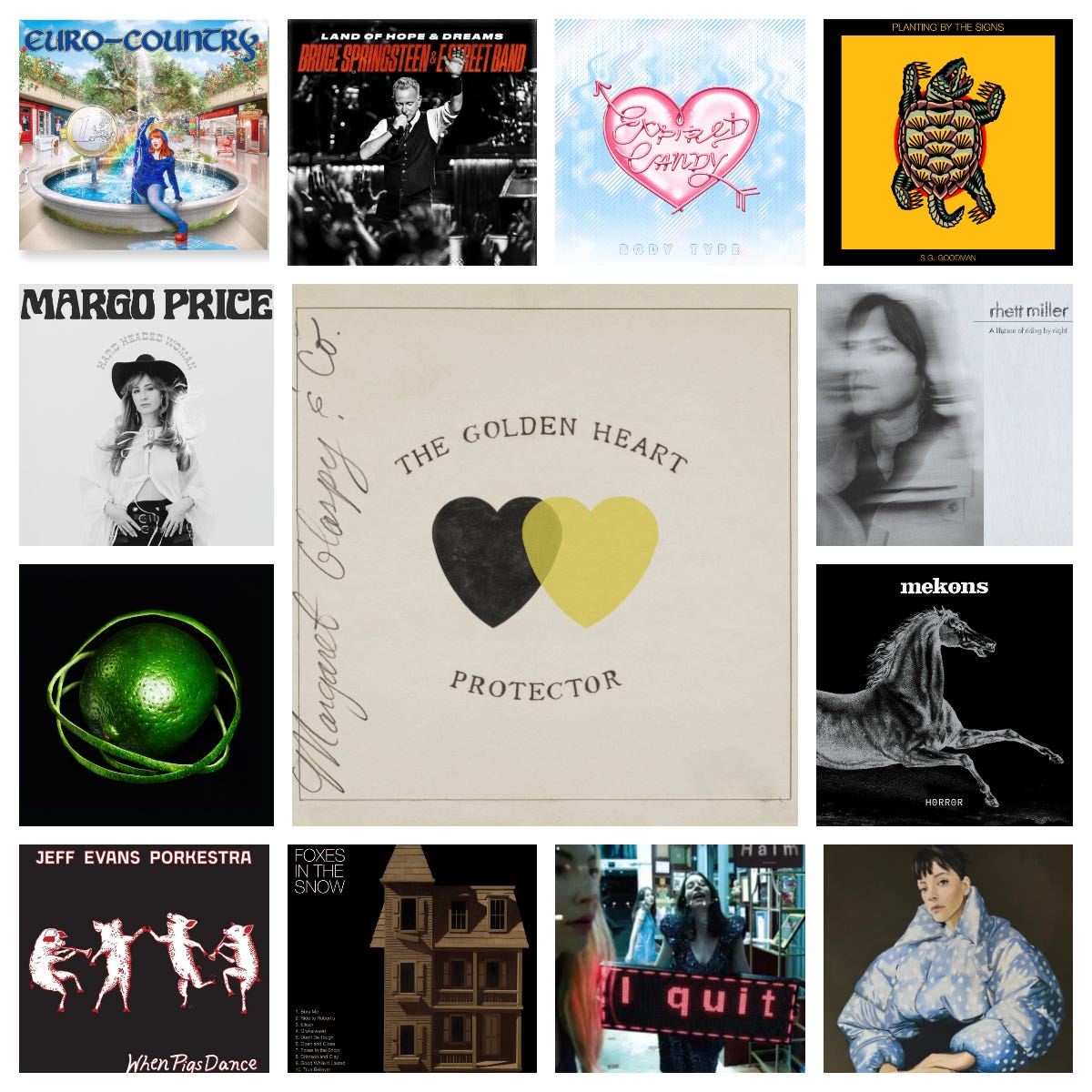
Having long ago appointed myself the Dean of American Rock Critics, I have dibs on a catchy cognomen for my version of the year‑end top tens or fifties or whatevers with which my tribe beefs up its December copy: the Dean’s List. I know—not only isn’t it December anymore, it’s May. So I’m way late with a “year‑end” list that stretches down to 61 picks. But looking over the year‑ends my colleagues at Rolling Stone and such have long since finalized, I don’t feel like I’m short‑changing my readers or myself. The internationally renowned Rosalia? I don’t speak Spanish and have major reservations about her grandiose musical romanticism, though it’s certainly distinctive and you have every right to disagree. The producer-singer-songwriter Dijon? We’ve all savored sharper condiments. Further over on the rock side, NYC’s Geese? Honk honk honk: “Bellowed, fatalistic, expressionistic moan” was the quick take I stand by. I can imagine other up‑and‑coming rockers on other people’s lists winning me over in the end. But most of the possibilities seem pretty iffy from here, especially the male ones. Which brings me to a striking stat about this year’s Dean’s List: 30 of its 61 picks spotlight female vocalists who include the Memphis rapper GloRilla, the now-transitioned Ms. Ezra Furman, and the eternal Sally Timms undercutting the Mekons’ Horror.
The way I figure, there’s a reason for this statistical anomaly, which reflects what musical entities I find myself responding to as I negotiate my eighties. One way of putting it is that as I age I prefer songs I said SONGS to the dub‑tracks‑sorta that sonic‑gestalt album fanciers like Dijon and Geese fans believe prove their aesthetic sophistication. Repeat: songs. From “In the Still of the Night” to “Don’t Be Cruel” to “At the Hop,” songs made rock and roll go as it dawned in my teen ‘50s. Indeed, what marketed itself as a two‑sided album music for well over half a century (although vinyl fetishists may stubbornly disagree, the album‑side thing, of course, failed to survive the CD era) is constructed from discrete songs that grab us one by one until at their best they cohere into musical wholes. As the singles music called rock and roll morphed into the album music dubbed just “rock,” poetically inclined collegiate folkies elevated the lyrical ambitions of the songs they wrote to embellish and empower their music as they strove to emulate the Beatles and the Stones. At more or less the same time, Nashville’s Music Row fed off, professionalized, and pretty much perfected pop songwriting per se, ending up with what they understood to be nothing less than not just an art form, which they cared about in itself, but a commercially potent fusion or amalgam of irresistible and well‑sung melodies shoring up meaningful verbal constructs capable of inflecting the love lives and even the world‑views of its audience. Soon hundreds if not thousands of rock bands followed suit, not to emulate Nashville per se but to kick off from its example to perfect what many already regarded as their “art.” As a result, descendants of the Beatles‑Stones‑Who triumvirate as well as countless American folk‑rock bands initially typified by the Byrds and the Lovin’ Spoonful made a thing of songwriting per se. And soon comparable goals were inspiring the scruffy upstarts of the more minimalist punk/new wave era.
All this is self‑evident enough. But I felt obliged to explain it in so many words to flesh out the evolving aesthetic expectations of what has long been a very much album‑oriented school of criticism that addresses everything from garage bands to rappers as well as ambitious aesthetes and accomplished pop professionals, all of whom traffic, once again, in songs. True, I feel obliged to credit and lucky to enjoy artists who get across principally on their fetching sonics and well‑honed grooves, particularly the funk/hip‑hop honchos and the many Afropop musicians I’ve been promoting for decades without understanding most of their lyrics at all. Prime African examples this year—four in all, though there are often more—include Malawi’s Kasambwe Brothers and Congolese Titi Bakorta’s Mapambazuko, both worth a dip on Spotify whether you think they’re your kind of thing or not. Moreover, not all that different formally or conceptually are, say, the Dingonek Street Band’s Primal Economics from Brooklyn and for that matter Chicago’s utterly un‑African FACS’s Wish Defense.
All these options feed off each other, and all embrace “rock” as a wide‑ranging sonic, aesthetic, and cultural phenomenon or maybe just catchword to which I’ve devoted my rather long life. So as I’ve gotten older I’ve found myself more and more taken with the telltale signs of maturity that have emerged from the youth music I’ve been fascinated by since I wasn’t yet a teenager—a music that keeps getting older itself. And speaking very generally I’d mention my special attraction to what over the years I’ve come to call for the sake of brevity “good albums” that fall into two or maybe I should make that three categories. Unreconstructed leftist that I will remain for what years I have left on the planet, I definitely have a thing for songs with politics, although they’re admittedly hard to do well: running down my list I’d cite Bruce Springsteen, Jason Isbell, Buck 65, Robert Forster, Chuck D of course, the all too obscure James McMurtry knocking it out of the park, Jeffrey Lewis, and there are more. A happily and indeed romantically married feminist till death do us part, I’m also biased in favor of love songs that nail connubial bliss, which it should surprise no one to be told are best left to women such as, for instance, Helene Cronin, Lucy Dacus, and Margo Price (who, FYI, also takes the trouble to ding “fascism”).
I could expand on these generalizations, but we are after all in Dean’s List territory, where were anybody doing the handicapping not a single reader nor for that matter your faithful dean expected to see Margaret Glaspy’s The Golden Heart Protector atop my list with its seven songs in 26 minutes. The possibility didn’t occur to me at first even though I actively perked up with my wife concurring every time I encountered the clarity of Glaspy’s delivery because I just liked the way it sounded. And that’s not all. At 37, the now NYC‑based Glaspy is a Californian who moved east with scholarship that took her through one semester of guitar studies at Berklee, and initially I didn’t quite grok her. But as I started replaying contenders so as to sharpen my chops as I prepped for this Dean’s List roundup, I found myself perking up every time her clear, conversational soprano‑plus came around on the changer till I wrote “There’s a sweetness here, but also thought and the kind of intelligence that values the lubricious without getting swamped by it”—and will now add that the album is jacked up by superb not to say revelatory cover versions that come alive as they honor history: Creedence’s “Have You Ever Seen the Rain?” with its dark “Yesterday and days before/Sun is cold and rain is hard/I know, been that way for all my time,” Jackson Browne’s “These Days” with its regretful “These days I seem to think a lot/About the things that I forgot to do for you/And all the times I had the chance to,” and most remarkable one I’m not sure I’d ever fully registered before, the Magnetic Fields’ “The Book of Love” with its “The book of love is long and boring/And written very long ago/It’s full of flowers and heart‑shaped boxes/And things we’re all too young to know.” All three of those citations are just samples; thanks to Glaspy, all three mine songs so substantial they’re worth sinking your teeth into. Without Glaspy I doubt I’d have thought of any of them ever again. But it seems likely that her album is going to be a standard around our house. One of many, sure. But there’s what can only be called a wealth of them by now, because a long life as a rock critic has made me the only kind of rich man I’ve ever much wanted to be.
Margaret Glaspy: The Golden Heart Protector (ATO)
CMAT: Euro‑Country (AWAL)
Bruce Springsteen: Land of Hope & Dreams (Columbia)
Body Type: Expired Candy (Poison City)
S.G. Goodman: Planting by the Signs (Slough Gates/Thirty Tigers)
Rhett Miller: A Lifetime of Riding by Night (ATO)
The Mekons: Horror (Fire)
Lily Allen: West End Girl (BMG)
Haim: I Quit (Columbia)
Jason Isbell: Foxes in the Snow (Southeastern)
Jeff Evans Porkestra: When Pigs Dance (self‑released)
Big Thief: Double Infinity (4AD)
Margo Price: Hard Headed Woman (Loma Vista)
Buck 65: Keep Moving (Handsmade)
Robert Forster: Strawberries (Tapete)
Public Enemy: Black Sky Over the Projects: Apartment 2025 (Def Jam)
James McMurtry: The Black Dog and the Wandering Boy (New West)
The Kasambwe Brothers: The Kassambwe Brothers (MASS MoCA)
Dingonek Street Band: Primal Economics (Accurate ‘18)
Todd Snider: High, Lonesome, and Then Some (Aimless)
Lambrini Girls: Who Let the Dogs Out (City Slang)
Sabrina Carpenter: Man’s Best Friend (Island)
Ale Hop & Titi Bakorta: Mapambazuko (Nyege Nyege Tapes)
Jubal Lee Young: Squirrels (Reconstruction)
Jax: Dear Joe (Atlantic)
Danny Brown: Stardust (Warp)
Marshall Allen: New Dawn (Mexican Summer)
Tyler Childers: Snipe Hunter (RCA)
Amanda Shires: Nobody’s Girl (ATO)
Wednesday: Bleeds (Dead Oceans)
Craig Finn: Always Been (Tamarac)
Adrienne Lenker: Live at Revolution Hall (4AD)
Ms. Ezra Furman: Goodbye Small Head (Bella Union)
Girl Scout: Headache (Human Garbage)
Common/Pete Rock: The Auditorium Vol. 1 (Loma Vista)
Chuck D Presents Enemy Radio: Radio Armageddon (Def Jam)
Amadou & Mariam: La Vie Est Belle (Because)
FACS: Wish Defense (Trouble in Mind)
Mahotella Queens: Buya Buya Come Back (Umsakazo)
Helene Cronin: Maybe New Mexico (self‑released)
Patterson Hood: Exploding Trees and Airplane Screams (ATO)
The Delines: Mr. Luck and Ms. Doom (Cortez)
Bill Scorzari: Sidereal Days (Day 1) (self‑released)
Manu Chao: Viva Tu (Because)
Billy Woods: Golliwog (Backwoodz Studioz)
Lucy Dacus: Forever Is a Feeling (Geffen)
Kadef: Kadef (RR Gems)
Willi Carlisle: Winged Victory (Signature Sound)
Corook: Committed to a Bit (Atlantic)
Grace Potter: Medicine (Hollywood)
Peter Stampfel, Friends & Daughters: Song Shards (Jalopy)
Funkrust Brass Band: Make a Little Spark (self‑released)
Jenny Hval: Iris Silver Mist (4AD)
Jeffrey Lewis: The EVEN MORE Freewheelin’ Jeffrey Lewis (Vintage Voltage)
Sudan Archives: The BPM (Stones Throw)
Neil Young and the Chrome Hearts: Talkin to the Trees (Reprise)
Wet Leg: Moisturizer (Domino)
GloRilla: Glorious (CMG/Interscope)
PinkPantheress: Fancy That (Warner Records)
Smerz: Big City Life (Escho)
Skrillex: F*ck U Skrillex You Think Ur Andy Warhol But Ur Not <3 (Owsla/Atlantic)
There were many other records A-listed last year that seem to have been overlooked:
Nakibembe Embaire Group: Nakibembe Embaire Group (Nyege Nyege Tapes ‘23) A
Champeta w/Edna Martinez: Diblo Dibala Special (NTS download). A
Charley Bliss: Forever (Lucky Number ‘24). A
Schoolboy Q: Blue Lips (Interscope ‘24). A-
Sabrina Carpenter: Short N Sweet (Island ‘24) A-
Edna Martinez Presents Pico! (Strut) A-
Hurray For the Ridf Raff: The Past Is Still alive (Nonesuch ‘24) A-
Nobro: Set Your Pussy Free (Dine Alone ‘23) A-
Towa Bird: American Hero (Interscope ‘24) A-
Mdou Moctar: Funeral for Justice (Matador ‘24) A-
Julien Baker & Torres: Send a Prayer My Way (Matador) A-
Eli “Paperboy” Reed: Sings Walk-in and Talkin (Yep ROC) A-
Aesop Rock: Black Hole Superette (Rhymesayers) A-
Rory Block: Heavy on the Blues (MC) A-
Lorde: Virgin (Universal New Zealand) A-
From the Dirt: Colored Edge of Memory (Partial Lyrics) A-
Joseph Kamaru: Heavy Combination 1996-2007 (Disciples) A-
Gurf Morlix: Bristlecone (Rootball) A-
Alick Nkhata: Radio Lusaka (Mississippi) A-
Saint Pierre: Luck and Gravity (Mutchcrud) A-
Luke Bell: The King Is Back (Thirty Tigers) A-
Hammel on Trial: Dirty Xmas (Saustex) A-
Nakibembe Embaire Group & Naoyuki Uchida: Phantom Keys (Nyege Nyege Tapes) A-
I only purchased two of your top 61 (The Mekons and Public Enemy), but really appreciate your critique of Geese. To your description "Bellowed, fatalistic, expressionistic moan", add "willfully awkward for the sake of appearing arty and deep".